Monday, July 23, 2012

Exhibition bits and pieces

Well I have come down to earth with a bump! I did 8 loads of washing over the weekend, I cooked dinner for 12 (for my whole family to thank them for their support with hanging the exhibition, cleaning, peeling off the vinyl lettering at the end, clearing up, plastering screw holes (er, the less said the better, the plastery stuff shrank and sank back into the holes), making and clearing food at the opening etc. I now have to mark some assignments and write a 2000+ word essay.

So life goes on - but in case anyone is interested I do have 2 hours of video and a time lapse photography sequence which I will link to, once I have worked out how to do something with it. I make stuff but have no idea of how to do video.

I have had a great response to the blog photos , wonderful comments,  thanks everyone.

I have to think - what next, do I aim high and risk rejection or just a bit higher and keep it manageable. We'll see. Mainly I just have to get through this year.

Ok - on a technical note - the exhibition pieces are wall hangings, not quilts. They are one whole layer with a second layer behind . However, I usually make quilts and these could easily be turned into a quilt except then they wouldn't be see through.  The stitching is done by free-machine stitching. I didn't use a programmed machine, I did it all myself by using a hoop to stop the fabric wrinkling (I hate using a hoop).

I used cotton thread which took the dye on the front and stayed white on the back . I expected the thread to take the dye better than it has.

They are  see through and look great in a window, unfortunately due to the high UV in New Zealand they would fade very quickly if I did that over here.

They are NZ$500 each (plus postage).


 Detail from day 3.

Oh - I never mentioned, what I called them.

I looked into fashion colour forecasting. I saw some Google Earth images where you can see the rivers running navy blue with dye run-off from jeans manufacture. I thought maybe it might be possible to work out what next year's fashionable colours might be, by looking at Google Earth.

From http://grist.files.wordpress.com/2011/03/google-maps-denim-dye-500.jpg

So here is
Spring/Summer Colour Forecast 2013
It is a bit of a mouthful but no-one really looked at the names anyway, they were too busy looking at the dye.


http://www.china.org.cn/english/environment/189819.htm

Here is a funny coincidence. I googled 'Clare Smith Watermark'. I was actually trying to find an article in a local newspaper which people keep telling me about, but we don't live in the area that gets that paper. So anyway - I googled my name and came up with a link to Clare Smith. I found I had made a film called Watermark and didn't know it.  It seems that another artist called Clare Smith has made a film called Watermark about a paper factory in Dover, England.

Saturday, July 21, 2012

Watermark exhibition - extras


This is me up the ladder pouring dye into the cups at the start of the day.

 Shadow on the wall behind the wallhanging

 When they were white the shadow was hard to see but as they became more and more coloured the shadow became more and more distinct. This the wall behind the green image on day 4
 Behind day 3 - red wallhanging
When I first started developing this technique this was my test piece. I have hung it in the window and it shows the details better. The window has wire squares so it looks like the image has a grid.

Friday, July 20, 2012

Watermark day 5

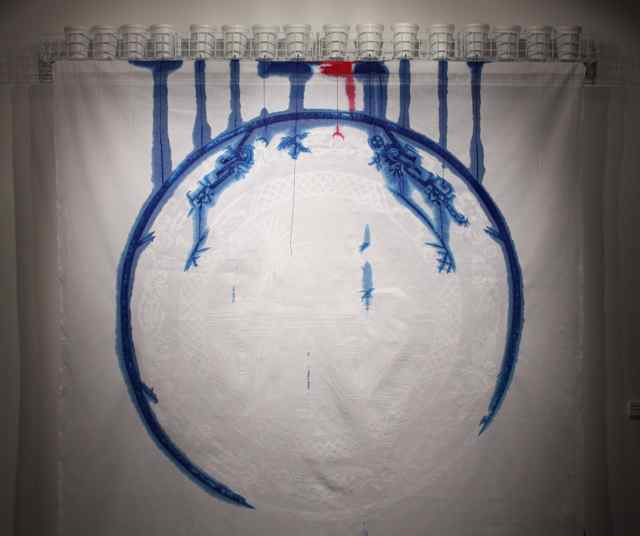
 Here is todays wallhanging. It is Zealandia - Karori Sanctuary in Wellington. It is a fenced sanctuary for native birds and has a big predator-proof fence.
 I chose the traditional blue like the willow plate but couldn't resist adding a bit of pink which turned purple.


 This is a final shot of the whole gallery with all 5 dripping dyed wallhangings. No. 1 and no.5 look as if they are  similar colours in this photo but they are quite different blues in real life.
Thats it folks - the show is over. I'd like to thank Clare Plug , Ian Smith, James Wratt, Margery Smith, David Wratt, Chris Wratt, Pheobe and Nina Smith, Deb Donnelly, Peter Deckers, Viv Atkinson and all the staff at the Visual Arts department of Whitireia Polytechnic for their help with this exhibition, I couldn't have done it without you!

Tomorrow- images of the shadows formed on the walls behind the hangings, incidental details, hopefully images of the fabric which mopped up the dye at the bottom (rolled up in the guttering).

Thursday, July 19, 2012

Watermark Day 4

Hi everyone
Today the wallhanging which got dyed is an image of the Victoria bridge on the Waikato River. I have dyed it green and red.

Here is the original (BTW they are photographed against a grey background to make the white image show up. Otherwise the white on white design would be too hard to photograph).


I took 80 photos of this one. I was trying out time lapse photography hopefully to turn into little movie. Tomorrow I am going to try videoing - it will have to be sped up about 6 times.

The picture of the ducks is by Melissa Anderson who came in just in time to see the ducks turn red.

Wednesday, July 18, 2012

Watermark day 3

Here is the image for day 3. Lake Matheson - a beautiful lake in the south island renowned for the amazing reflections of the mountains.


The two bottom photos are detail shots of some of the more intricate areas. I tried not to put too much dye through today so that I could keep some of the detail.

Tune in tomorrow for day 4!

Tuesday, July 17, 2012

Watermark Day 2

Here is the image for Day 2's Vertical dyeing performance!

A friend of mine lived on a lifestyle block north of Wellington and I have modelled this image on a little cottage and bridge on her land. This is dedicated to Jan. S.


Here is what happened when the dye started running. I haven't got as many pictures of this piece as I was distracted by something else that was going on at the time. I will come to that later.

The official opening was tonight too. Everyone who stopped to chat seemed to like it. It seems to be particularly appealing to scientists who want to know why some colours spread through the fabric faster than others. This one may radically change in colour overnight as I topped up the cups with a darker blue.

On a technical note - they are made of a very stiff type of cotton. The dye travels to where there are two layers or where there is thread embroidery. At the moment they have not had soda ash put through them so are not fixed. I cut out the outside patterns by putting all five together and cutting through all 5 with a craft knife. It was a bit like a Chinese papercut.

The reason for a lack of photos of this one is because when I arrived at the gallery someone had parked their bike there and chained it to the post in the room. Here it is chained to a post in front of my artist statement.  I went steaming off to try and get them to move it. Which I did very badly and not at all successfully. Someone more tactful than me, went and asked nicely later and it was finally moved at lunchtime. Whew!

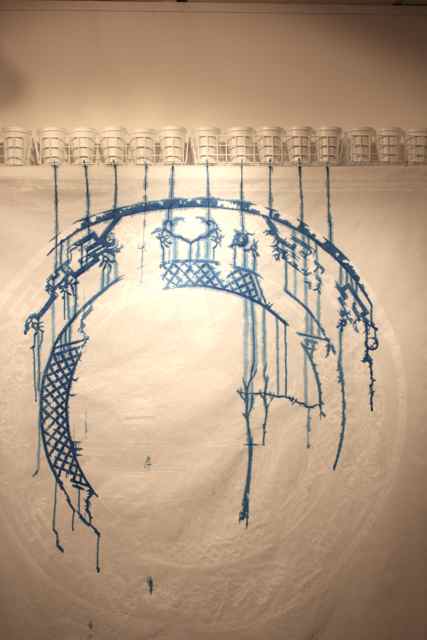
This is a detail of part of the wallhanging dyed on day 1. The fabric has dried and you can see a shadow on the wall behind. When the fabric is white it makes a light shadow but once it is dyed it leaves  a much darker shadow.

Now I have to go and make up the dyes for day 3. Tune in again tomorrow!
Clare

Sunday, July 15, 2012

Watermark exhibition Day 1


This is the first wall-hanging before the dye starts to drip. The central image is Pauatahanui Inlet near Porirua, New Zealand. The building is a bird watching hide and the estuary/inlet is a haven for all sorts of waterbirds. The outside patterns are from the willow pattern plate.

Here is my artist statement for the exhibition.


Watermark

 The inspiration for this exhibition came from a quote.
“The Chinese textile industry creates about 3 billion tons of soot each year, and a single mill can use about 200 tons of water for each ton of fabric it dyes. Millions of tons of unused fabric are burned or sent to landfills each year when dyed the wrong colour. Rivers run red or chartreuse, or teal, depending on what colour is in fashion that season – with untreated toxic dyes washing off from mills.” (Menon, 2010).

Dye pollution occurs in many textile-producing countries.  Western consumers demand lower and lower prices for clothing forcing manufacturers to cut corners to save money. Water treatment processes are expensive. Meanwhile New Zealand remains ‘clean and green’ and the pollution happens somewhere else, ‘out of sight, out of mind’.

Would we put up with our rivers turning pink or teal or scarlet according to fashion?  Probably not.  Instead our waterways are contaminated with invisible pollutants.  Nutrients from farm fertilisers, heavy metals in storm water and high bacteria levels from dairy farming.

Not so clean and green after all. 

And now for the exciting bit - when the dye starts to run. The colours for today - Delft Blue and pink.


Apologies for the photo colours - I will re-work some of them in photoshop. I can't quite work out how to change the white balance to deal with halogens (no setting on my camera).

This has been an exciting dyeing day, and I didn't get any on the carpet - honest!

Please leave a comment so I know you are there.
Clare