Saturday, August 29, 2015

New Zealand Textiles at The Knitting and Stitching Show, UK

For me, 2015 has been the year of exhibiting my work in the UK. I came to live in New Zealand in 1975 as a 15 year old. I've been back to the UK a few times but have never really exhibited my work there, so its most unusual for me to have the opportunity to show my work in the Uk, three times in one year! I'd like to thank Laura Kemshall and Annabel Rainbow for all their hard work getting the first two shows together and Alysn Midgelow-Marsden from NZ for the third (see below).

The first show was with the ThroughOurHands group and was curated by Laura Kemshall and Annabel Rainbow. It was held in Bilston and I really wish I could have seen the whole show as it looked like there were some amazing pieces.

The second show was also with 'ThroughOurHands' and was part of the Festival of Quilts in Birmingham. Laura and Annabel produced a lovely catalogue/portfolio book for the show which can be purchased on the Throughourhands website.

I produced a new wallhanging for this show. It was made in the pojagi style and I incorporated pieces of hand dyed but unfixed red fabrics into the hanging. When water was dripped from the top, the red dye bled into the surrounding fabric along the seam lines. Again, this work was about dye pollution.
Canary in a Coalmine

detail of Canary in a Coalmine

I am still trying to find a decent picture of this piece. I like subtle :-) but I think people preferred the more dramatic colors of Bitter Harvest, my other piece which was also dyed on the wall.

Here is a link to Helen Conway's blog where she talks about some of the pieces in our show, and you can see how one of my other pieces was dyed.
Bitter Harvest at the Festival of Quilts
The above photo was 'borrowed' from Laura Kemshalls' blog post for the show.


My third Uk show this year is an exhibition of textile work from New Zealand. It is curated by Alysn Midgelow-Marsden and will show at the Knitting and Stitching Shows in London, Dublin and Harrogate.
Over the next few weeks we are raising money to help pay for the expenses of getting the work to the UK and on the walls. We have a Boosted page where anyone can donate a little to get the work there.

Here are the names of the textile artists represented in this show

 Sandra Hall
Mia Hamilton
Michelle De Silva
Colleen Planck
Jo Kinross
Joyce Fleming
Joyce Stalker
Katherine Bertram
 Lea Wald
Margaret Johnstone
Ronnie Martin
Sherril Jennings
Yoke Martens
Yvonne Hamond
Clare Smith
Sarah Pumphrey 

If you donate some money to the Boosted page , the money only comes out of your account if we reach our target of $2200 . I understand that you may also be able to claim back some of that money in your tax refund. The total currently is $550 so we are a quarter of the way through which is fantastic. 

Thankyou any donors!
Clare

Tuesday, May 19, 2015

The Liberated Quilt Exhibition Bilston, UK

My textile installation 'Bitter Harvest' which is dyed on the wall ( I call it vertical performance dyeing), is part of a group show at Bilston Craft Gallery in the UK. The exhibitors are agroup of international quilt/textile artists exhibiting under the group name ' Throughourhands' and the show has been organised by Linda Kemshall and Annabel Rainbow.

I would have loved to have been at the opening but it was not possible at this time. Although I might get to the UK and Europe in October this year, but that doesn't coincide with either of the shows I will be in this year!
The vertical dyeing pieces plus a new and as yet unfinished piece will be shown at Festival of Quilts in August. I am grateful to ThroughOurHands for making it possible for me to show my performance dyeing pieces in the UK.
In the meantime I should be making the piece for this show, the idea is in my head but house renovations ( kitchen, dining room, lounge) plus preparing my mother's house for sale keeps me out of the studio. 

Sunday, November 23, 2014

Around the World Blog Hop


Today I am posting as part of the Around the World Blog Hop. I was 'tagged' by Alison Schwabe. Alison currently lives in Uruguay, but I first met her when she was based in Perth , Western Australia. This is a link back to Alison Schwabe's blog.  When I first saw Alison's work, she was working on a  series called 'Ebb and Flow' which I still love. If you want to see more of Alison's quilts click the link to her blog and choose 'galleries'.

As part of the blog hop we are asked to answer four questions.
1. What am I working on?
2. How does my work differ from others of its genre?
3. Why do I write/create what I do?
4. How does my writing/creating process work?


I am working on a textile piece for a show in the UK.
I belong to a group called 'Though Our Hands' and we are having a group exhibition next year. Here are the details. The Show is to be called "THe Liberated Quilt: New Work From Through Our hands" at Bilston Craft Gallery from 9th of May to 4th of July 2015.


Anyway, as I said, I am working on a piece for this exhibition, here is what I have so far, but I have plans, and it won't look much like this at the end. The final piece will be dyed whilst it is hanging on the wall of the gallery (as long as the gallery can cope with that).
These are actually completely white pieces but they are extremely hard to photograph so I put it on the table so there was some color coming through. I have no idea why it turned out so blue but it gives the idea. here it is, in front of the window so you can see that it is translucent.
You are seeing my neighbor's house and the hills on the other side of the valley.

Today I also dyed 20 metres of fabric for my own use and to sell at a market day coming up. I WILL get around to ironing them before the day of the sale.
How does my work differ?
Hmmm well no-one I know of dyes their work on the wall of the gallery, so thats pretty different!

Here is a before shot of one of my installations in Objectspace, an Auckland Gallery and below is what it looked like after red and yellow dye had run down it for a few days.

My work usually has some kind of theme, in the past I have made quilts about pollution, the weather, climate change and human genetics. I'm not against decorative quilts, I make that kind for the beds in my own house, but the quilts or textiles that I exhibit usually have a message somewhere.


My current series was inspired by a remark that you could predict the next seasons trendy colors by looking at dye pollution in rivers on Google Earth. Then I started thinking about all that dye getting into the food that people eat so the bowls at the bottom have food in them.


3. Why do I create the things I do?
I really like to draw people's attention to issues, and I just happen to do that with fabric and thread. I originally trained as a radiographer and then did a science degree and then did an art course specializing in printmaking. I like to make stuff with my hands and I like to show people new ways of looking at issues.

4. How does my creative process work?
Well I went to art school, and I was trained to write everything down. Every idea, every new recipe, every artist who  might have influenced my ideas. We were trained to constantly ask ourselves why we were doing something. So I have masses of sketch books, full of 'stuff', even after graduating ages ago, I still write stuff down. I do a lot of research, I sketch, I make samples.

Some of my sketchbooks

Inside my current sketchbook
This is just what I am working on currently, if you would like to see some of my older , more traditional quilts please have a look at my website, which I am afraid is very out of date, I'm hoping to have a new website soon .

The next people I have tagged on the blog hop are:
Shirley Goodwin, from Oamaru, New Zealand.
Lisa Call, from Denver, Colorado.
Shirley is a quilter, a dyer extraordinaire and also teaches for the Academy of Quilting.

I met Lisa Call  at least 22 years ago, on Quiltnet, we connected because we both had kids the same age and were struggling to be creative as well as be parents of young children. When she came to New Zealand with her family we met in person. Her style of quilting has evolved hugely in that time, and now instead of being a computer programmer, she is a professional and very successful quilter and quilt teacher. Lisa is coming back to NZ, this time to teach at Fiberarts NZ in Whanganui on April 12-18th 2015.


Thursday, November 20, 2014

Travels, Berlin, and hand dyed fabrics.

I'm just procrastinating before dyeing some fabric. It is quite an upheaval to move enough stuff out of the laundry area in order to set up all the dye buckets. Maybe I will work outside today, it is windy but warm here in Wellington, New Zealand.

I'm going to be experimenting with the recipes in this book. The Fabric Dyers Dictionary.
My usual 'go to' dyers book is Color by Accident by Ann Johnston, but today I feel I'd like to try something new.


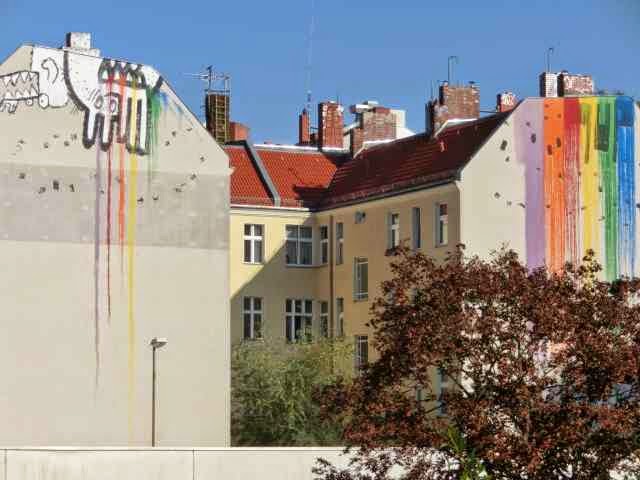
In the man time here are pictures from our trip to berlin, very little textile work, and mostly fantastic graffiti.


Wednesday, November 19, 2014

Travels, Art and Textiles : Boston

After San Francisco I headed over to Boston to see another old school friend. I'd seen her several times over the years but I have never visited her at home. I had no idea that her house is on the edge of a State park. She may have told me years ago, but somehow I had never worked out what that meant. Her garden is teaming with birds, squirrels and I even saw chipmunks. I spent quite a long time with the camera zoom lens trying to take pictures of all the birds and animals.


It was in Boston that the trip became more about textiles. We did a day trip to Lowell. I had read about Lowell when I was looking at the history of the cotton industry as part of my research on cotton and its effect on the environment. Lowell was full of cotton mills and employed a lot of young women from very rural areas. The mill owners were keen that the girls were well looked after.  There were boarding houses with strict matrons, evening lectures and a chance to earn money and be educated. they worked hard but it seemed like it was a lot healthier than the English cotton mills.

I loved Lowell and would have liked to have spent longer there. It was Autumn and the trees were starting to change color, and there was so much cotton history to explore.

We went to the American Textile History Museum which had a touring section of the Fiberarts Exhibition on display while we were there.
Gigantic looms which still work

 I love this black and white woven bedspread and wonder how I could translate this into cloth.

We also went to the New England Quilt Museum which I found a little disappointing but I think that is because I am not a traditionalist. It had some nice costumes and some of the fabrics were great. I'm sure if I lived there, I would use the library. They had a sale of second hand books which people have donated to the library. Quilters all have extensive book collections and she they downsize or move on, they or their families donate the books to the Museum . If they already have a copy they will sell the duplicates as a fundraiser. I didn't see anything I needed but it was worth a look. 


On another day trip we went to Newport and I was amazed at the enormous mansions which were only used as 'holiday homes'. The mansions are filled with gold, glitter, statues, marble and other expensive fittings. They were used for about 4-6 weeks a year and crockery, cutlery and table linen were moved back and forth between the owners multiple homes. I realized that the fictional character Cora, from the Downton Abbey TV series was supposed to come from this sort of family.

 On a much more austere note, this is one of the childhood homes of Louisa May Alcott. It was an experiment in community living which her father was involved with, but it failed in about 10 months after the families nearly starved. They had arrived too late in the year to plant crops and the men were away when the crops needed to be harvested.
Pumpkin time in New England.

I really loved the area around Boston and would love to go back and explore for longer next time.
Below are botanical and zoological specimens made from glass. These are part of the collection of Harvard University and are on display there. It is quite hard to believe they are glass, the workmanship is extraordinary.


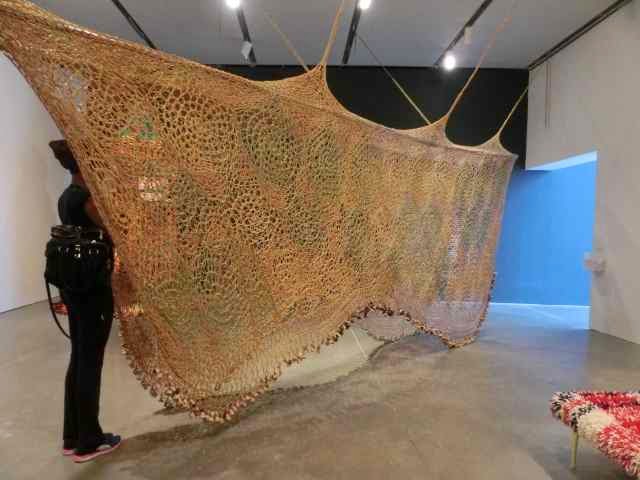
 Below is part of an exhibition of fibre art at the Institute of Contemporary Art, Boston (ICA)

Work by Ernesto Neto

Although I went to the gallery to see the Fibre art show, the exhibit I most enjoyed was called 'The Visitors' by Ragnar kjartansson  It consisted of 9 video screens showing musicians playing a song in different rooms of a large house. They can only hear each other through speakers. They appear to walk from screen to screen and eventually end up all on the same screen walking away downhill still singing.I found it mesmerizing and am still thinking about it today. I do hope that it eventually finds its way to our city gallery.