Friday, April 27, 2012

Conceptual art

Sometimes I think I'm living in a different world from most of the tutors and at least some of the students. So I've been reading a lot of books and looking at websites trying to find conceptual art that 'speaks to me' and that I 'get'.

 I thought I'd share some of the interesting stuff I have found along the way. Some of it is conceptual art and some is just fun.

Shoes that make everyone the same height by Hans Hemmert

Also by Hans Hemmert , these yellow balloons.

On a more serious note this pile of candy by Felix Gonzalez-Torres is called 'Portrait of Ross'
Find out why by clicking on the link above. When I read about it, it all made sense.

Here's something I saw in a show at the Manawatu art gallery years ago and I can't find a picture of it or find out who made it. An artist had sculpted legs made of brown sugar. It was about amputations of limbs because of diabetes (hence the sugar) and the artist was talking about Pacific Island people and diabetes. It was very clever and I would love to be able to show a picture and put the artists name if anyone knows who it is.

This is really interesting from a design perspective.
Samantha Murray made 5 fruit scented liquid fabric dresses for her final year at Massey University.

I'll add more as I re-find all my favourites of the last few weeks.

Clare
P.S Are any of you from Russia? I found out that there are more page views on my blog from Russia than any other country. Either I have a number of fans in Russia who look at this blog occasionally, or one person looks at this blog a great many times a day or a computer is trying to find a way to spam me :-) So if you are from Russia please say hi so I know you are a real person!


Wednesday, April 25, 2012

Auckland, solo shows and 'stuff'


Sunset in Auckland (Symonds St)


Here are a couple of photos from Auckland. My eldest son has gone there to study Jazz at Auckland University and I took my younger son up there for the holidays for a visit. Music son was trying to fit in 8 hours of practice a day during the holidays so we didn't see much of him. My husband went to a conference in Marrakesh for pretty much the whole holidays.

Anyway, I managed to get to see the exhibition 'Kermadec' at the Maritime museum which is great. I really recommend this exhibition to anyone who has a chance to see it. The band 'One Direction' was staying at a hotel very close to where we were staying. I had to wear earplugs to get to sleep to cut out the noise of all those screaming teens.

We are only 2 days into the new term and  today is a public holiday for  Anzac Day so I have been working on some of the weird experiments required as part of the course. Today I have made a sponge and feather mockup of a sparrow, tried and failed to smash up an old road reflector and hung a line full of washing over a stream (with the help of various members of my family). The sponge and feathers sparrow hasn't been used yet so I can't tell whether it will be successful or not. The road reflector is a dead-end I think and the washing over the stream was supposed to look like dyed clothes dripping into the stream but the sun went behind a cloud and really all it looked like was a washing line on a camping trip. Never mind - we have to try these things.
I should explain that as part of the course we got 2 mystery 'materials' and a word and we have to use these together for experiments and try to incorporate them into our body of work for our solo exhibition (which is looming fast and I haven't even worked out what I am making).

So my 2 mystery materials were a packet of pigeon feathers and  a road reflector, (probably dug up in the numerous road works on in wellington all the time). My word is 'Impact'.

I've had fun with the pigeon feathers which I dyed blue,  however the road reflector is pretty much indestructable. I have hit it with a sledgehammer, attempted to crush it and hammered nails into it but most of them bent. In the end all I have been able to do is use it to make an impact on something else.


 It is very hard to make any sort of impression on the reflector


So I used it to make an impression on some camping mat foam. I'm short so I have cut the bottom 30cm off my foam camping mat. Then I warmed it up with the heat gun but heating it up with iron works as well, as long as you cover the foam with tin foil first. Then when it has been warmed till it looks like it is changing a bit on surface, push the object you want to get an impression of, into the foam. Then you can ink it up to make a print or paint it and use it for some other purpose.

The gold sprayed foam impressed with the back of the reflector which is studded with gravel, looks a bit like a slice of toast. Unfortunately I have no real use for toast-like bits of camping mat right now.

Here are some other shots from the park where we went to take fake pictures of clothes dripping into the stream.
 This is the Bucket tree. World famous in New Zealand :-)
Here is a quote * Tawa's Bucket Tree, which is registered as a notable tree, is thought to have been first pruned into shape by Frederick Westbury, who worked for landowner William Earp, in the 1880s. It is actually a group of about five macrocarpas. 


Underneath the tree is an amazing tangle of branches.


So this is what I did on Anzac Day 2012...


Sunday, April 8, 2012

Water, Water

I seem to be doing nothing much but reading at the moment, however by the end of the Easter holidays I need to be sure of what I am going to make or it is going to be pretty hard to get together a whole solo show by July (unless I look for a very small venue).

I have a back up plan - a booking for an unfinished upstairs gallery, but I'm looking for somewhere on street level if I can find something suitable.

Anywhere here is a book that has scared me recently
When the Rivers Run Dry - Fred Pearce. This book was a bit of a revelation. He mentions the term 'Virtual water'. This is the economists term for all the water that was used to produce a manufactured item. It was invented by Tony Allan of the school of Oriental and African Studies in London.

New Zealand sells kiwifruit to overseas countries and is therefore exporting water inside the fruit which ends up in another country. Which is Ok for us, at least we have rain (often a bit too much rain). But what if it is a dry country exporting tomatoes which have been irrigated -  the amount of water inside the tomato is added to the water that was used to irrigate the tomatoes. The 'Virtual water' count can be huge.

Fabric grows in a hot climate and needs lots of water for irrigation, then gets dyed, rinsed and rinsed and rinsed then scrubbed and faded (In the case of jeans). The Virtual Water count for cotton is enormous.

If it takes 25 bath tubs full of water to grow enough cotton for a t-shirt then it is probably similar for a metre of quilting cotton. The water for growing cotton is being pumped out of rivers and used to irrigate the cotton which is grown in very dry places, almost deserts, and this is causing the rivers to run low and in some cases dry out. Have a look here for pictures of the Aral Sea. This is before the fabric gets dyed and rinsed and then taken home and washed to remove the starches and finishes and to shrink it.

The Aral sea 
The water was pumped out of the rivers which feed the Aral Sea to irrigate cotton.

Now I love cotton, and I love to dye cotton and I'm no purist but I'm starting to think about the implications of my choices of materials so I'm reading books on sustainability. I haven't found many books by contemporary quilters which consider the environmental issues of the materials they are using. However there are lots of people in the fashion industry who are looking at becoming more eco-friendly or sustainable in their work but there are so many factors to consider.

You can recycle and use up scraps - quilters used to be very good at this and to be fair, some still are.

People are designing clothes which use every scrap of fabric instead of all the trimmings going to the landfill

You can use organic cotton (try googling suppliers of organic cotton in NZ and it isn't easy to find)

You can dye with natural dyes

You can make things out of more sustainable fabrics like Tencel

But it is pretty hard to do all of this at the same time.

So I have an idea for an exhibition but it involves lots of 3 metre long white fabric lengths. I would have had no difficulty in the past in buying a 50 metre bolt of homespun and getting started but now I'm having to consider how I am going to get the fabric by other means.

Recycled fabric?

Upcycled fabric?

Pieced together scraps?

What if I buy the 50 metre bolt of new fabric and promise to use very scrap of fabric? Does that count? Or should I try and find organic cotton (and believe me that doesn't seem to be an easy task). And in my heart of hearts I'd love to use cotton organdy, which is white and crisp and has been treated with starches and chemicals causing goodness knows what environmental problems.

Now time for some more light-hearted stuff. Check this website for weird craft.


 Here is something I found in a op shop in Wellington, New Zealand.


 Its a crocheted doiley with swans. Anyone know what is is for? Is it just decorative or does it hold scones or something?

Monday, March 26, 2012

Experiments

Hi anyone who reads this occasional blog. I go through spates of writing lots and then write nothing for weeks. I think it is time for a catch up.

I have a mixed media piece in the "Changing Threads' exhibition  which is on in Nelson at the moment.  It is called Tsunami (II) and commemorates the 2011 Tsunami in Japan. My sons and I had been travelling in the area that was hit by the tsunami only 6 weeks before.
The layers are kimonos stacked on top of each other.

I mentioned in the last post that I am doing research on cotton production. Mostly I have been looking at the pollution that results from dyeing cotton. Most of the pictures unfortunately come from China. Greenpeace has been doing a lot of research on textile pollution in China and has targeted some of the big sportswear companies to show them what is really happening in their supply chain. I watched some videos from the Greenpeace website and I came very close to tears. We can pat ourselves on the back and say how 'Clean and Green' we are, while China is trashing it's environment to bring us cheap goods. The big chainstores have demanded cheaper and cheaper clothing and to do that, manufacturers in China have had to cut a lot of corners in order to make a profit. It makes me look at cheap jeans in a very different light. Ok so I know there are a whole lot of other factors at work and I don't want to get too much into that. As an artist I'm more interested in showing rivers which change colour depending on what the next season's fashionable colour is. Pink is the new black etc.

I have tentatively chosen the title 'Out of Sight, Out of Mind' for my project/solo exhibition which has to happen some time before the end of July even though I haven't booked a space and don't really know what I will be making.

In the meantime, here are some of the experiments I have been doing. I'm playing with 3 dimensional shapes instead of quilting for a change. Perhaps it is time to move away from 2d into mixed media, but it depends on what works.

 These are experiments with plastic bags when I thought I might like to have a look at plastic in the oceans and the Great Pacific Garbage Patch.
 Here are some strange things made in a hotel room on the weekend I had to drive to Auckland to drop off my son's drum kit. I got bored with plastic bags and changed to an old wool blanket I found for $2 in an op shop. Mostly I made sort of worm shaped things.
 Then when I got back to a place where I could work with messier stuff, I tried dipping wool in wax and plaster of paris. The red ball of wool dipped in wax is great because it looks so soft but when you pick it up it is hard.
 Then I started doing research on jeans. Stone wash and sand washed jeans are very unfriendly to the environment and also to the health of the people working in the factories.


I had fun with satay sticks and a hot glue gun until I found I was on the same path as several other students without knowing it.

More to follow...

Sunday, March 4, 2012

Teaching and Learning

I had high hopes of making more regular posts on this blog this year but as usual life got in the way.

I am teaching 3 hours a week at Whitireia Polytechnic in Porirua, I'm a Tutorial assistant for 2 days a week and I'm also a Graduate Diploma student there. So I'm back to being a student again.

I'm trying to get my brain organised so that I don't forget anything, or miss a deadline.

I hope to be able to put some images here when I have something to show.  At the moment I am trying to get research done on where our cotton fabric comes from (as Quilters) and what environmental issues we should be considering. However I keep getting distracted by research about pollution from dyeing jeans in China.

Tuesday, January 31, 2012

Tokyo Quilt Show 2012, Bernina NZ icons challenge

Sadly I didn't go to the Tokyo Quilt show this year but someone else did and has posted their photos on Flickr.
Tokyo Quilt Show 2012  . My personal favourite is 'Born Free' by Miyoko Miyata, the quilt which is grey with a green seedling. Looks a bit like the idea for the movie WallE.

Here is my entry for the Bernina New Zealand Icons Challenge. I had real problems coming up with an idea for this quilt challenge. I felt I had 'done' New Zealand icons already, NZ cabbage trees (Cordyline Australis), lancewoods, Nikau palms etc. In the end I made a quilt because I had told Mary from Nancy's Embroidery shop that I'd enter. I had to make it in the time between getting back from Hong Kong and going off to the Coromandel on holiday with the family. I didn't bother about housework or anything anything for that week even though we took down the Christmas tree and the floor was covered in bits of Xmas tree plastic.

While I was away I got a text from a friend saying "Thankyou for telling me about the Bernina challenge, I entered and I made a bach quilt". Groans from me, as I made a bach quilt too!
Congratulations to the winner of the sewing machine,  Rosemary Rush from Auckland for her Tuatara quilt.

Which brings me back to the idea of Challenges and theme exhibitions. Are they a good thing? They break you out of a rut, get you making something and get your stuff out there and on show.  OR do they take you off track and distract you? I'm not sure myself, all I know is that my quilt will be a useful image for this year's Christmas card and I finally got around to making a quilt with a picture of a pohutukawa tree on it (the tree with the red flowers).

Well, back to work. 2 things to work on - an entry for the Nelson exhibition 'Changing Threads' due on the 17th of Feb and getting my eldest son organised. He has been accepted for music school in Auckland so will be moving out of home and into the student residences for a year.

Last thing
I went to the wedding dress exhibition at Te Papa in Wellington and it is great. Take your friends (and  your Mum).

Saturday, January 28, 2012

Holiday in the Coromandel

Just a few shots of the Coromandel area of New Zealand for those who live outside of New Zealand and are interested. The weather is warmer than Wellington, the vegetation can be quite tropical looking and there are lots of holiday homes for those from Auckland who can afford it. We just borrowed a house in Whangamata for 12 days and used that as a base to see the rest of the peninsula.
 This tree was laden with epiphytes (plants growing from the branches)
 Punga (tree fern)

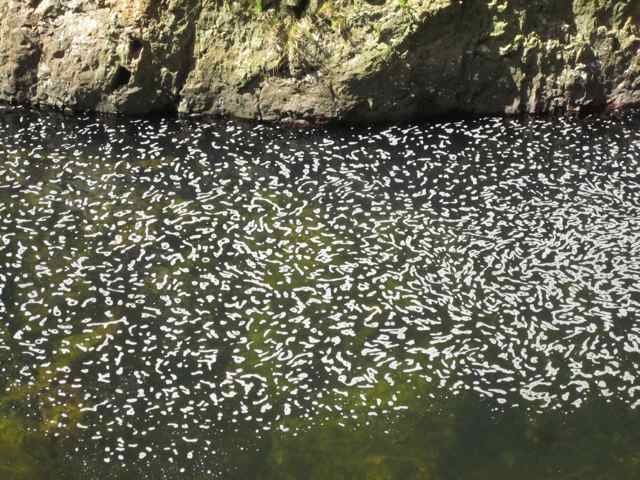
 Froth on the river, possibly caused by pollen as we all got hayfever that day.


 View from the top of Driving Creek Railway, Coromandel Town.
 Driving Creek Railway
Waihi Open Cast Gold Mine